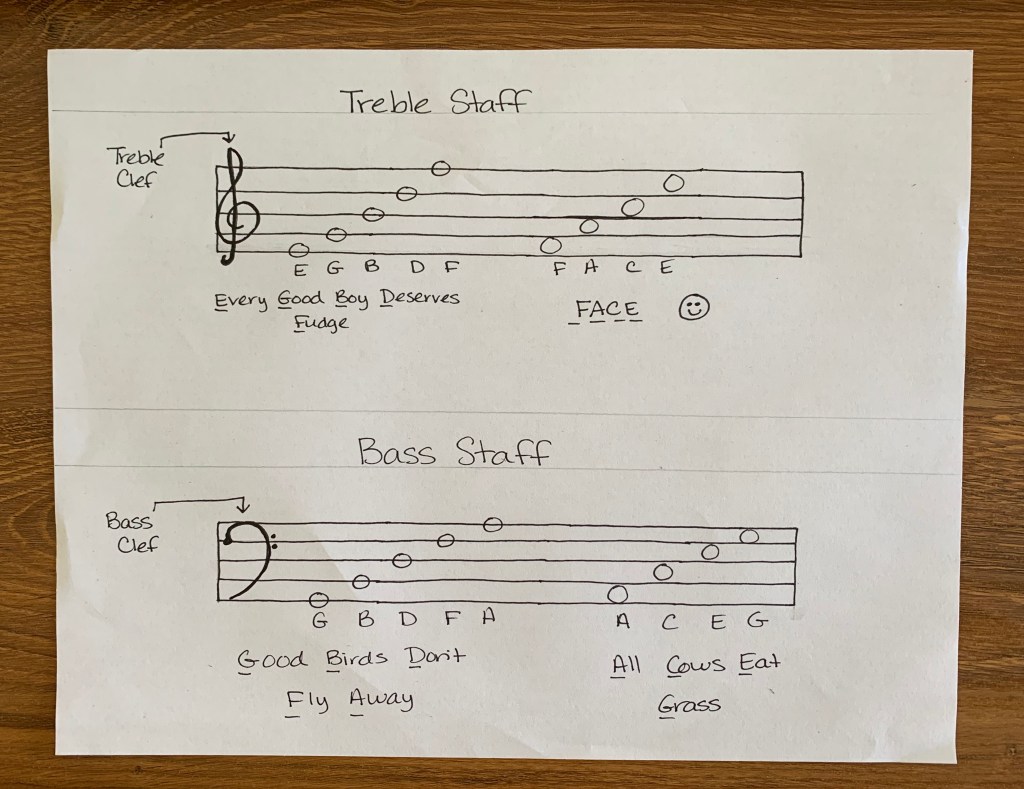
One of the first and most important things we need to learn when playing any instrument is how to read the music. Reading music is like learning another language. It takes time and lots of practice and use before you can read and understand it fluently. There are lots of components to learning to read music, but we’re going to focus on one of the main components: how to read the letters of the notes.
When we look at the music staff, we notice there are 5 lines, and in between the lines are 4 spaces. These lines and spaces hold most of the notes that we will use, though some notes can go beyond those lines and spaces. But that’s for another discussion. For now we will stick to discussing the notes that stay on the staff.
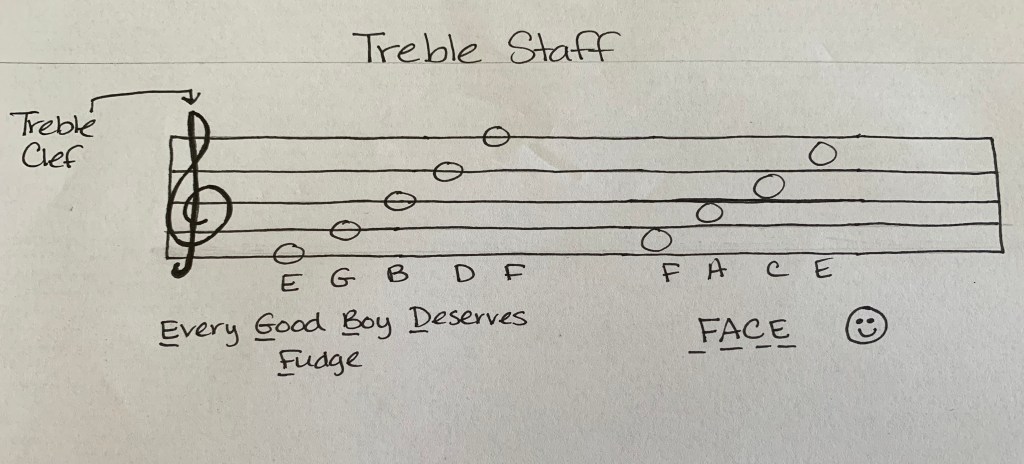
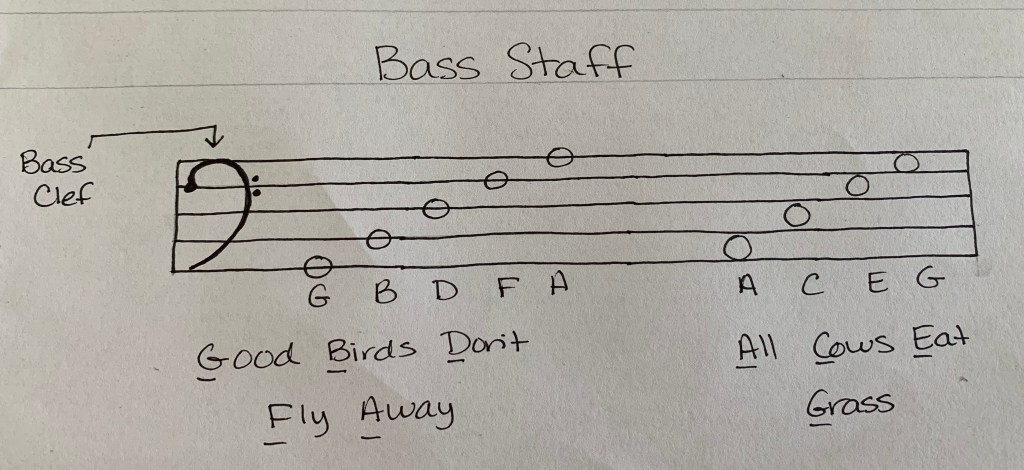
Each line and space is assigned a letter from the music alphabet—ABCDEFG. How do we remember where those letters go? Simple answer— a mnemonic device. A mnemonic device is a method of learning something by memorization of patterns of words or letters. The mnemonic device we use for memorizing letters of the staff is a combination of these 4 phrases: Every Good Boy Deserves Fudge, FACE, Good Birds Don’t Fly Away, and All Cows Eat Grass.
But what does that mean? Let me explain. For the right hand (RH) on the piano or for higher sounding instruments, like flute or higher voices, we use the Treble Clef. And to read the letters on the treble staff, we start from the bottom up, with the lines as EGBDF, and the spaces spell out FACE. Using the letters of the lines, we create this saying Every Good Boy Deserves Fudge, and of course, for the spaces…well…hopefully that’s self-explanatory!
For the left hand (LH) on the piano or for lower sounding instruments, like the tuba, or lower voices, we use the Bass Clef. To read the letters on the bass staff, starting from the bottom up, the lines are GBDFA and the spaces are ACEG. For these lines we say, Good Birds Don’t Fly Away, and for the spaces we say All Cows Eat Grass.
Once you’re able to memorize these sayings and what they represent, learning to read the letters on the staff is a snap! And when you continue to practice at it, reading notes will become like second nature to you!
If you’d like to have a free copy of this chart to print out and keep next to your piano, or in your music book or your practice space, click on the link below. I would suggest even printing it out on cardstock or heavy paper, and then laminating it so its less likely to get lost or messed up, and you’ll always have it as a reference.

 Miss Donna 4 Music